

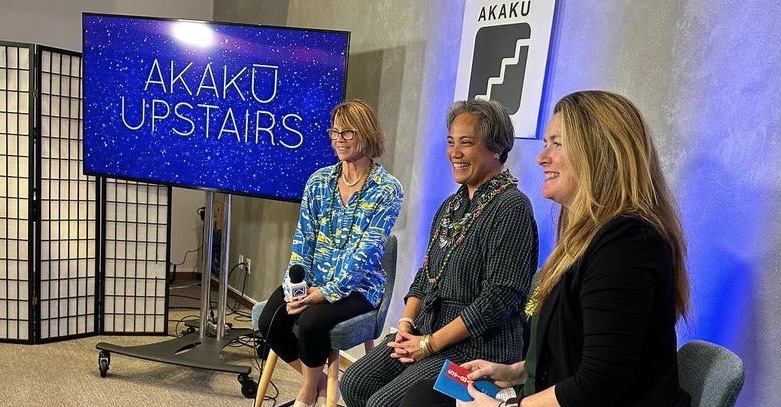


Akaku Webcam

Drew's expertise and advice in film, media, web video and marketing has resulted in contracts and consulting agreements with dozens of companies around the United States. Along the way he's addressed thousands of people through workshops and presentations he's given, throughout the U.S. and Canada. Drew is one of the pioneers in the live streaming field. Realizing early on that streaming would grow to have a significant impact on the world he began to research and learn about it. Along the way he was fortunate to be hired to live stream some significant events and quickly became a recognized expert in this emerging field.

There is a new land grab in Hawaii whereby the government is giving away valuable public land to private business without getting anything in return for the people. Sound familiar? It has happened before in Hawaii – with agriculture, with beaches, with water and now, with the public airwaves. This time the difference is that the land in question is in the form of public electronic real estate, the electromagnetic spectrum. These are the frequencies you pay for to watch cable TV, use the internet or talk on the phone.
Most people don’t know this, but in exchange for using public rights of way - airwaves, telephone poles, electric wires and underground conduits - cable monopolies like Oceanic Time Warner have to pay “rent” in the form of community access channels like Olelo on Oahu, Akaku on Maui, Na Leo on Big Island and Hoike on Kauai. Now, because of new technology, the frequencies or space these channels occupy have suddenly become extremely profitable to cable companies. (Not unlike how lands once granted to indigenous people by treaty became more valuable once minerals were discovered.) That is why Time Warner wants to take over this public property and move these channels to inferior locations while vastly reducing the amount of non-commercial electronic real estate. That is why, if you are an Oceanic Time Warner Cable subscriber, channels are disappearing from your channel line-up altogether, or re-appearing someplace else. So far, instead of holding your land in public trust, the state is falling for the Time Warner plan - hook, line and sinker.

I’ve recently returned from Maui, HI where our Generation ZD partner, Akaku: Maui Community Television, has launched an innovative digital media program called Project YBEAM (Youth Broadband Education & Awareness Mentoring). Project YBEAM is a youth civic journalism project that seeks to expand access to communications and broadband technology in/for Maui's marginalized communities.
In Project YBEAM, students ranging in ages 12-18 years old participate in an intensive 12-day Digital Literacy Curriculum. Each class day, students learn skills in journalism, video production and broadband technologies like wireless and fiber optic systems. Class discussions focus on topics such as media literacy, civic engagement, community responsibility, ethical awareness and cultural values. Awareness, skills and action are tied together with the introduction and distribution of “MoJo” kits.
The term and practice of “MoJo” (mobile journalism) has been around since 2005, but it was only within the last year that it has become available to rural youth in Maui County. MoJo production kits are deceptively simple, but have proven to be extremely powerful tools in the creation and distribution of engaging stories.
Does a $50,000+ job with Oceanic Time Warner create a conflict of interest for legislator?

March 2nd, 2012 · Ethics, Legislature, Politics · Excerpted from i L i n d — Ian Lind • Online daily from Kaaawa, Hawaii
http://ilind.net/2012/03/02/does-a-50000-job-with-oceanic-time-warner-create-a-conflict-of-interest-for-legislator/#comments
Here’s a question about the Legislature’s web site: When members of the House or Senate disclose a conflict of interest, is there a record of that conflict which is accessible to the public?
The question occurred to me after a recent post about the bills impacting Olelo and the other community access television providers. I wondered whether Kauai Rep. Jimmy Tokioka had publicly disclosed his new job with Oceanic Time Warner, which creates at very least the reasonable perception of a conflict of interest. And I wondered if that information would be easy to locate.
Tokioka filed an amended financial disclosure with the State Ethics Commission on July 25, 2011, to report getting a job as business manager, Kauai operations. for Oceanic Time Warner Cable. His disclosure lists a salary in the $50,000-$100,000 range. That’s more than his legislative salary, possibly considerably more.
Tokioka is a member of the House Finance Committee, which ended up as the sole referral for HB2874, one of the cable bills that has stirred up controversy. The status page for the bill indicates Tokioka voted in favor, along with the majority of the committee. Tokioka reportedly has also been active behind the scenes seeking support from key colleagues in pushing cable-related bills forward.
Oceanic, which often finds itself at odds with the community access corporations funded by its franchise fees, is seen as a key interest behind these cable-related bills.
Jay April, president of Akaku: Maui Community Television, recently emailed the organization’s supporters:
Akaku Latest Events
- Studio Production
May 17, 2012 - Studio Production
May 18, 2012 - Studio Production
May 19, 2012